Choosing custom grillz comes down to one decision most buyers underestimate: the metal. The style, the tooth count, and the finish all matter, but the alloy you pick sets the price, decides how long the piece survives daily wear, and determines whether it still looks sharp in five years. Gold grillz, sterling silver, plated pieces, and stone-set designs are not interchangeable, and the differences are measurable rather than cosmetic. This is a metals-first guide to specifying a grill you will actually be happy wearing.
What a Karat Number Actually Means
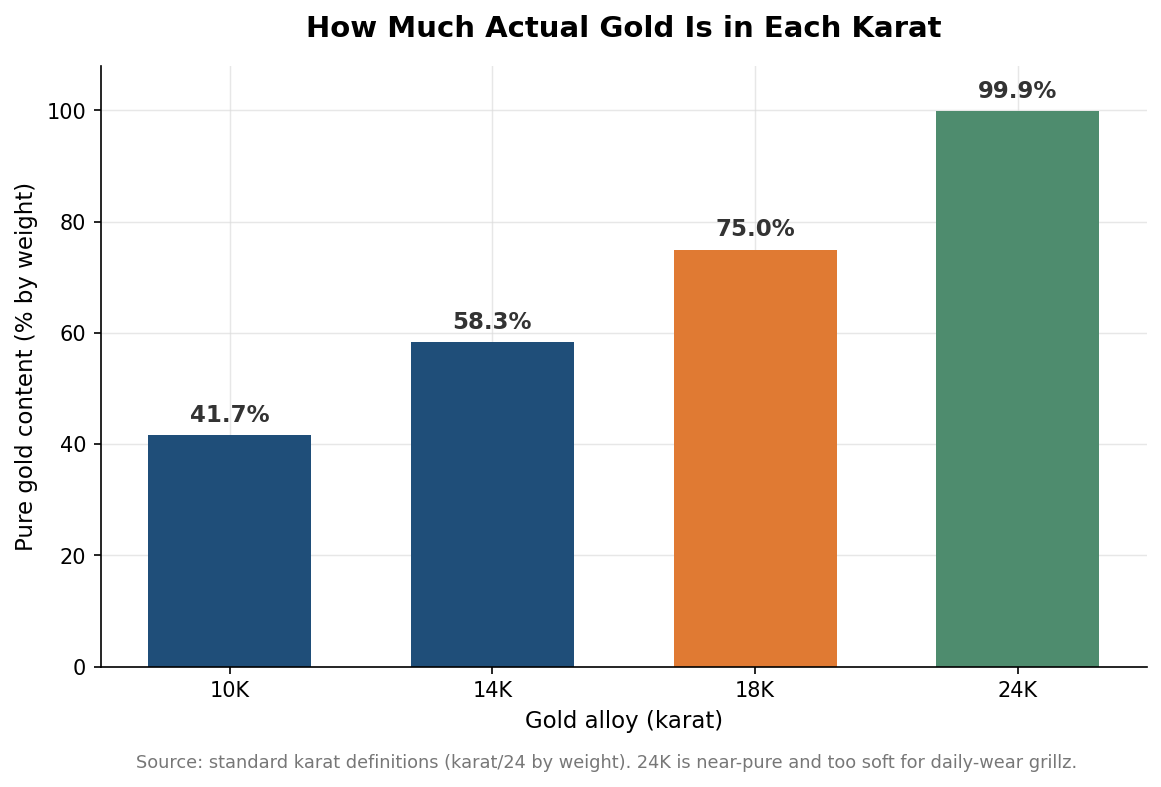
Gold purity is measured in karats out of 24, and that fraction is literal. A 10K alloy is 10 parts gold to 14 parts other metals, which works out to roughly 41.7 percent gold by weight. 14K is 58.3 percent, 18K is 75 percent, and 24K is near-pure at about 99.9 percent. The rest of the mix is copper, silver, zinc, palladium, or nickel, and that alloying is what gives colored golds their tone: copper pushes toward rose, palladium or nickel toward white, a balanced blend toward classic yellow.
The counterintuitive part is that more gold is not better for a grill. Pure 24K gold is soft enough to bend and warp with normal handling, which is exactly what you do not want on a piece that clips over your teeth and comes in and out daily. The alloys people actually wear are 10K and 14K, because the added metals harden the gold and make it far more resistant to scratches and deformation. 18K is available and looks richer, but it is measurably softer than 14K and shows wear sooner. If durability is the priority, the lower karat is the smarter buy, not a compromise.
Solid, Plated, and Sterling Silver
The single biggest quality distinction is solid versus plated. A solid gold grill is cast entirely from the gold alloy, so the color and value run all the way through the metal. A plated or gold-bonded piece is a base metal, often brass or sterling silver, with a thin layer of gold applied to the surface. Plated grillz cost a fraction of solid ones and look nearly identical on day one, but the plating wears through at contact points with handling and saliva, and once it does the base metal shows. Plated pieces are best understood as short-term or occasional-wear items, not heirloom purchases.
Sterling silver, marked 925 for its 92.5 percent silver content, sits in a useful middle ground. It is a genuine precious metal cast solid, it takes a bright white polish, and it costs dramatically less than gold. Its trade-off is tarnish: silver oxidizes and needs periodic cleaning to stay bright. For a buyer who wants a real solid-metal grill without a gold budget, or who wants to test a style before committing to gold, 925 silver is the honest entry point rather than plated brass.
What Each Option Costs
Grillz are usually priced per tooth, then multiplied by how many teeth the design covers. A single open-face or closed tooth is the base unit, and the common configurations are the top six or top eight, with matching bottoms available. For plain, no-stone solid gold, current market guides put 10K in the range of roughly 200 to 500 dollars per tooth, 14K around 250 to 700, and 18K around 300 to 900. A typical six-to-eight-tooth set therefore lands somewhere between about 1,200 and 4,000 dollars depending on karat, tooth count, and design complexity.
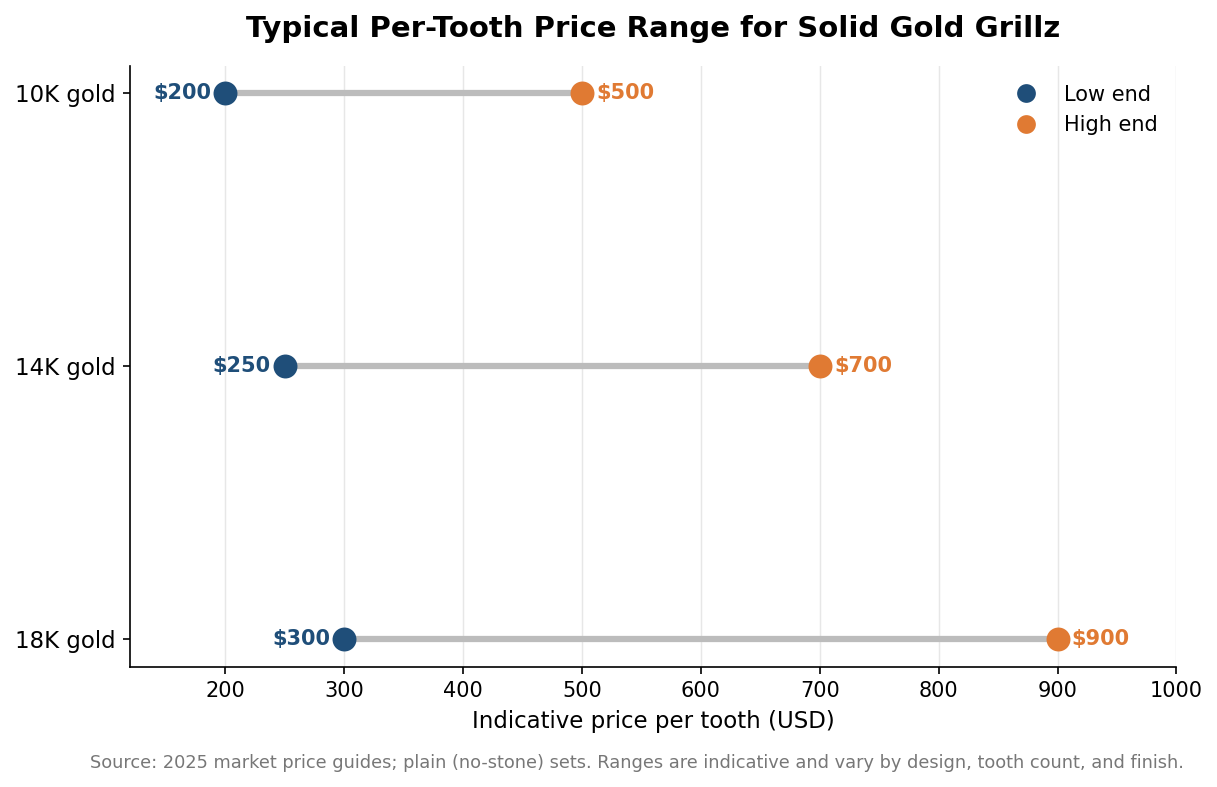
Those bands are indicative, not quotes. The final figure moves with the current spot price of gold, the weight of metal each tooth requires, the cut style, and whether the piece is made from a true custom mold or a stock fit. Stones change the math entirely: natural diamond grillz commonly start above 1,500 dollars per tooth and full diamond sets can run from five figures well into the tens of thousands, while lab-grown moissanite delivers a similar sparkle for a small fraction of that. Sterling silver, by contrast, keeps a plain custom set in the low hundreds rather than the low thousands. When you compare quotes, confirm whether a price is per tooth or per set, and whether it is solid or plated, because those two variables explain most of the wild spread you will see online.
From Impression to Finished Grill
Custom pieces are built from a mold of your own teeth, and the fit is only as good as that impression. A standard mold kit contains trays and alginate putty; you mix the putty with cool water, seat it over your teeth for roughly 90 seconds, and let it set into a precise negative before sending it back. From there a shop pours a dental-stone cast, produces a CAD model for your approval, and casts the approved design in your chosen metal under pressure. The piece is then fitted to the cast, filed for alignment, and polished; stone-set designs add hand-setting time on top.
Plan the timeline accordingly. From the moment a usable impression is received, a plain custom grill typically takes about two to four weeks to produce, and stone setting can add several more days. A sloppy impression is the most common cause of a grill that rocks or does not seat, so it is worth redoing the mold rather than shipping a marginal one. If you are ordering for a specific date, count backward from that deadline and add mailing time in both directions, because the impression has to travel to the shop before the clock on production even starts.
Specifying the Right Grill
Put the decisions in order and the choice gets simple. Decide solid versus plated first, because it is the difference between a piece that lasts and one that wears out. If solid, choose 10K or 14K for everyday durability and treat 18K as a look-focused upgrade rather than a stronger one. Pick the color your wardrobe leans toward, set the tooth count and whether you want tops, bottoms, or both, and only then decide on stones, which are the largest single cost lever. Get those five variables right and the metal will do its job for years; get the impression right and it will fit like it was cast for the one mouth it was, because it was.