“How much do grillz cost” has no single answer, because a custom set is priced like any other piece of fine jewelry: by what it is made of, how much of it there is, and how far you take the finish. The same six-tooth set can run a few hundred dollars in plain silver or well into five figures once you flood it with natural diamonds. This breakdown separates the four levers that actually move the price — metal, tooth count, stones, and labor — so you can build a realistic budget before you send off an impression.
The metal sets the floor
Everything starts with what the grill is cast from, because precious metal is sold by weight and karat, and a mouthpiece uses a real amount of it. Sterling silver is the entry point: a single plain tooth commonly falls in the $100 to $250 range, which is why silver is the usual choice for a first grill or a simple look. Gold is priced by karat, meaning the percentage of pure gold in the alloy. A plain 10K tooth typically runs about $200 to $500, 14K roughly $250 to $700, and 18K around $300 to $900, with the spread on each driven mostly by how much metal the tooth design uses. Higher karat costs more per tooth because there is more pure gold by weight in the same piece — not because the shop charges a premium for the color. In fact many makers charge the same for yellow, white, or rose gold, since it is the karat and the gram weight that determine cost, not the tint.
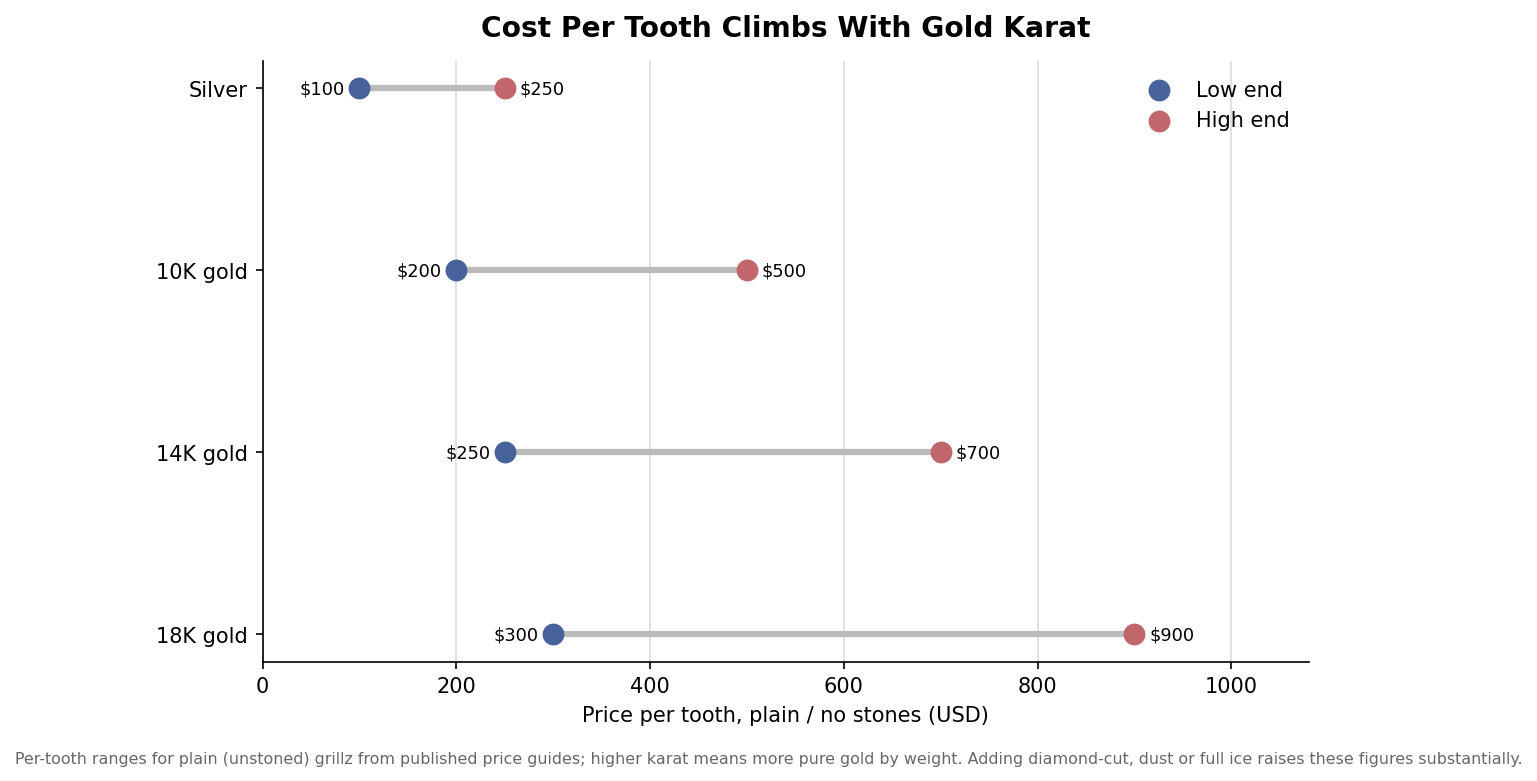
One practical note on karat: 10K is the most durable everyday option because the alloy is harder, while 18K is softer and richer in color. That trade-off, not just price, is worth weighing if the grill will be worn often.
How many teeth you cover
The second lever is simple arithmetic: the more teeth you cap, the more metal and labor go into the piece. Grillz are usually ordered by the arch and the count — a “bottom 6” or “top 6” covers the front six teeth on one arch, an “8 on 8” covers eight, and a full set covers both arches. Because pricing tends to scale close to per-tooth, doubling from six teeth to twelve roughly doubles the metal cost before any stones are added. If you are budget-conscious, a bottom 6 in a mid-karat gold is the configuration most buyers start with, since the bottom front teeth show the grill clearly while keeping the tooth count — and the bill — in check.
Plain, diamond-cut, or iced out
The finish is where budgets stretch the most, and it is the number-one reason two quotes for “the same” set look nothing alike. A plain grill is polished solid metal and sits at the prices above. A diamond-cut or “dusted” finish uses tooling to carve a sparkle pattern into the metal itself, adding shine for a modest labor charge without any actual stones. Setting real stones is a different tier entirely. Lab-grown moissanite gives a fully iced look at a fraction of diamond cost — a moissanite-set gold set commonly runs from around $2,000 up past $10,000 depending on coverage. Natural diamonds sit at the top: expect roughly $1,500 and up per tooth, with fully flooded six-to-eight tooth diamond sets ranging from about $10,000 to $50,000 or more. If you want the iced look without the diamond budget, moissanite is the lever that gets you there.
What a full set actually runs
Putting the metal and coverage together, here is the realistic range for a common 6-to-8 tooth set by material. Plain silver lands around $400 to $800; 10K gold roughly $1,200 to $2,500; 14K about $1,500 to $3,000; and 18K around $2,000 to $4,000. Add moissanite and the same gold set jumps to the $2,000 to $10,000 band, while natural-diamond versions climb off this scale entirely. Treat these as planning ranges rather than quotes — the exact figure depends on the gram weight of your specific design, the tooth count, and the finish.
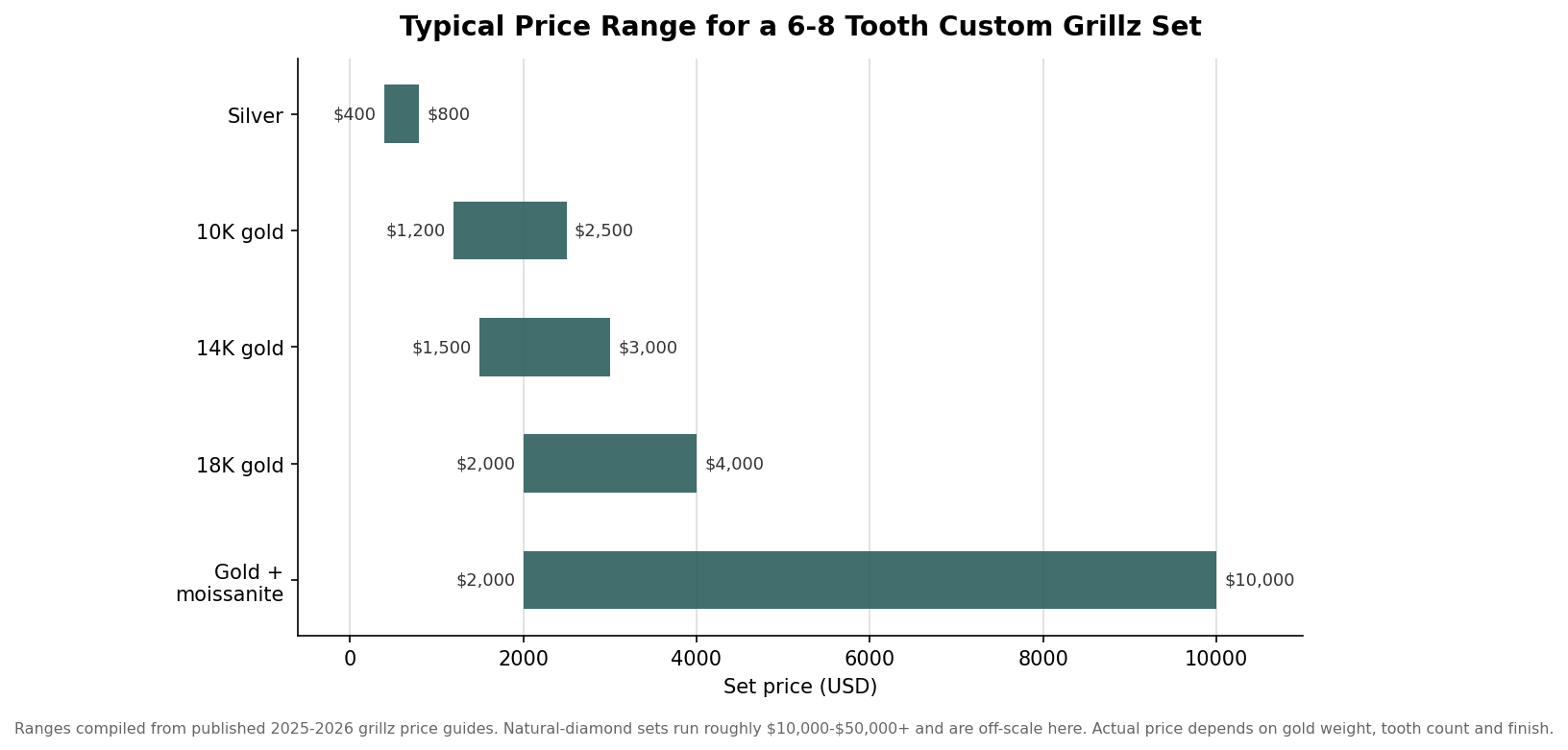
The pattern to take away is that metal choice sets your starting point, tooth count scales it up more or less linearly, and stones are what turn a four-figure set into a five-figure one. If a quote surprises you in either direction, one of those three levers is the reason, and asking the maker to itemize them makes any price easy to sanity-check.
Turnaround, impressions, and ordering
Custom grillz are built to your mouth, so the process adds time that pre-made pieces do not. You start with a dental impression — most bulk and online makers mail a putty mold kit you set at home and send back, or you can have a dentist take one. From the point the shop receives a good impression, a common end-to-end window is about two to four weeks, though a plain set can be faster and a heavily iced set slower, since setting stones is painstaking hand labor. If you are ordering for a specific date, build in buffer for the impression to travel both ways and confirm the production window in writing before you pay. The quality of that impression matters more than anything else you do, because a poor mold produces a poor fit no matter how much you spend on metal.
How to budget without overpaying
Start by fixing the two levers that anchor the price: pick a metal that matches how often you will wear it, and a tooth count you actually need rather than the largest one offered. From there, decide whether you want stones at all — a diamond-cut finish delivers noticeable shine for a fraction of what set stones cost, and moissanite delivers a fully iced look for a fraction of natural diamond. When you request a quote, ask for the price broken into metal, tooth count, finish, and any stone work as separate lines. A set priced that way is easy to compare across makers, and it tells you exactly which lever to adjust if the total comes in above your budget. Whatever tier you land on, the impression is the one place not to cut corners, since fit is what separates a grill you wear from one that sits in a drawer.