Ordering a custom grill is really four decisions stacked on top of each other, and most of the confusion comes from trying to make them all at once. Break it into a sequence and it gets simple: how many teeth, what cut, whether to ice it, and finally the metal and fit. Work through them in that order and you end up with a piece that matches the look in your head and the budget in your pocket, rather than a surprise quote and a shape you did not expect.
Decision one: how many teeth, and which ones
Start by deciding how much of your smile the grill covers. Sets are counted by the number of teeth capped, and top and bottom arches are ordered independently in sizes that typically run 4, 6, 8, 10, or 12 teeth. The classic starting point is a “six,” which spans canine to canine across the front of the smile and reads as a full grill from a normal talking distance without wrapping all the way back. Going to eight or ten pushes the metal further toward the molars for a bigger presence; dropping to a single tooth or a pair of fang caps on the canines is the most understated option. A common combination is a matched top and bottom six, but there is no rule that the arches must match, and many people ice only the top while leaving the bottom plain or skipping it entirely.
Decision two: the cut and the finish
The cut is what gives two grills with the same tooth count completely different personalities. A solid or closed-face grill covers the whole tooth surface, creating an unbroken shield of metal and the boldest shine. An open-face grill, sometimes called a window grill, does the opposite: it frames the perimeter of each tooth and leaves the natural enamel exposed in the middle, a subtler look that still reads as custom work. A deep-cut grill is machined so the metal follows the natural gaps and contours between the teeth, giving crisp separation and a more realistic, sculpted appearance instead of one flat plane. Beyond those, fang or K9 caps sharpen the canines, bar grills run a horizontal band, and two-tone pieces mix rose, yellow, and white metal within a single row. A light diamond-dust finish scatters small stones for texture without the cost of a full flood, and gap-filler pieces double as a way to bridge a space between teeth while adding a design accent. None is better than another; they are aesthetic choices, so pick the one that matches how visible and how ornate you want the result to be.
Decision three: plain or iced, and which stone
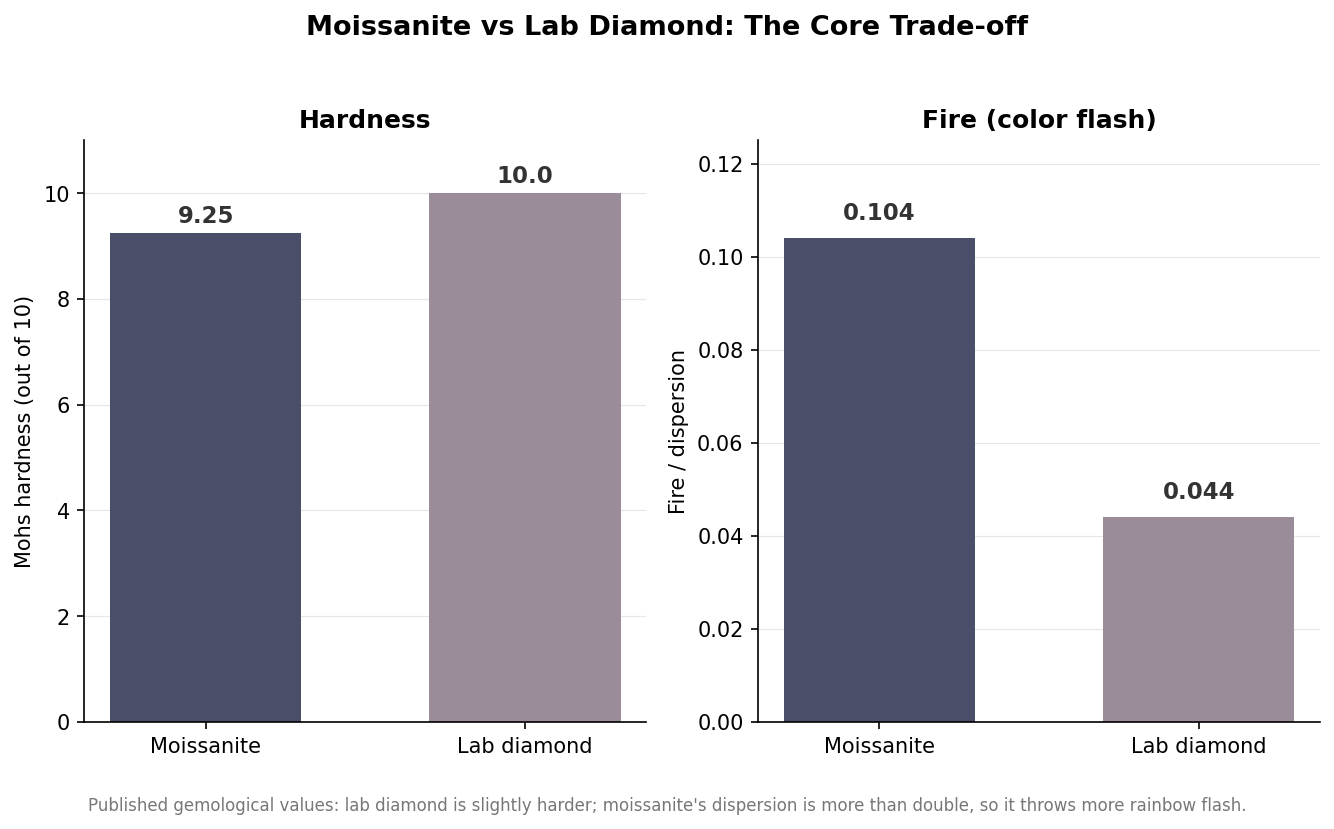
This is the decision that moves the price the most. A plain polished grill lets the metal do all the talking and is the most durable and affordable route. An iced or bust-down grill floods the surface with dozens or hundreds of hand-set stones, and here the real fork is moissanite versus lab-grown diamond. The two look similar from across a room but differ in ways that matter up close. Lab diamond sits at the top of the hardness scale at Mohs 10, a touch above moissanite’s 9.25, so both are tough enough for daily wear. The bigger visible difference is fire: moissanite’s dispersion of 0.104 is more than double a diamond’s 0.044, which is why it throws noticeably more rainbow flash, while lab diamond gives a cleaner, whiter classic sparkle.
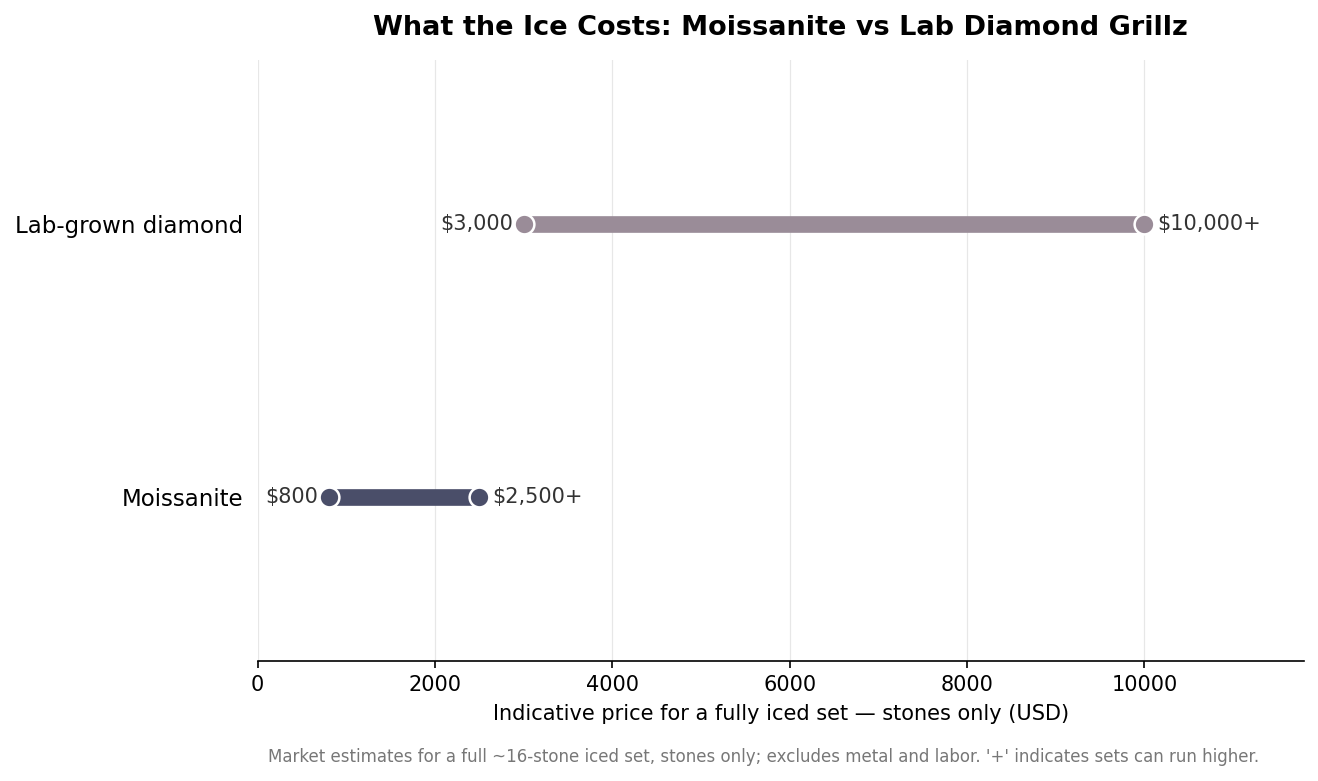
Cost is where they truly separate. Moissanite commonly runs roughly $40 to $100 per carat, putting a fully iced set in the neighborhood of $800 to $2,500 or more for the stones. Lab-grown diamond runs far higher, often $300 to $800 per carat, with a full iced set landing anywhere from $3,000 to $10,000 and up. Those are indicative market ranges for the stones alone and do not include the metal or the labor of hand-setting, but they show the order-of-magnitude gap clearly. On top of the stone choice you will pick a clarity tier, with VVS being the cleanest commonly offered grade, and a setting style such as honeycomb, pave, prong, or a flooded invisible look that changes how densely the ice reads.
Last calls: metal, fit, and living with it
With shape and sparkle settled, the remaining choices are quicker. The metal, whether 10K, 14K, or 18K gold or sterling silver, sets the base color and durability and interacts with the stone choice, since a whiter metal flatters diamond while yellow gold warms up any setting. Fit comes down to the impression: a clean, accurate dental mold is what makes the finished grill seat snugly and comfortably, and a rushed impression is the single most common reason a piece feels off. Finally, treat the grill as the removable accessory it is. Dentists generally advise taking grillz out to eat and to sleep, keeping them and your teeth clean, and steering away from permanent dental modification, all of which protects both your enamel and your investment. A soft brush, a gentle jewelry cleaner, and a dry case between wears are enough to keep both metal and stones looking new. Handle those basics and a custom grill stays comfortable and bright for years.
Run the four decisions in sequence and the whole process loses its mystery. Choose your tooth count for coverage, your cut for personality, your ice for shine and budget, and your metal and fit for comfort and durability. Each answer narrows the next, and by the end you have specified a piece precisely rather than guessing at it.