Most of the money wasted on custom grillz is not spent at the checkout — it is committed earlier, in a handful of specification choices that are hard to undo once the piece is cast. A grill is made to a mold of your own teeth, so it cannot be resized or returned like a ring, and the wrong call on metal, stones, or the impression itself tends to mean paying twice. These are the mistakes that cost buyers the most, and how to avoid each one before you approve an order.
Rushing the dental impression
The single most expensive mistake happens before any metal is involved. A custom grill is only as accurate as the impression you send, and a rushed or under-filled mold is the leading reason a finished piece does not seat properly. When the putty is mixed too slowly, seated crooked, or pulled before it has set, the lab is casting to bad data, and the result is a grill that rocks, pinches, or will not clip on. Because the fault is in the mold rather than the workmanship, a remake usually means buying a second impression kit and starting over. Take the impression unhurried, follow the set times exactly, and check that every tooth you want covered is captured cleanly with no drags or bubbles before you send it.
Buying stones on looks alone
“Iced out” covers four very different stones, and choosing by sparkle in a photo rather than by how the stone wears is a classic error. The four common options line up predictably on hardness, and hardness is what determines whether the ice still looks good in a year of daily wear.
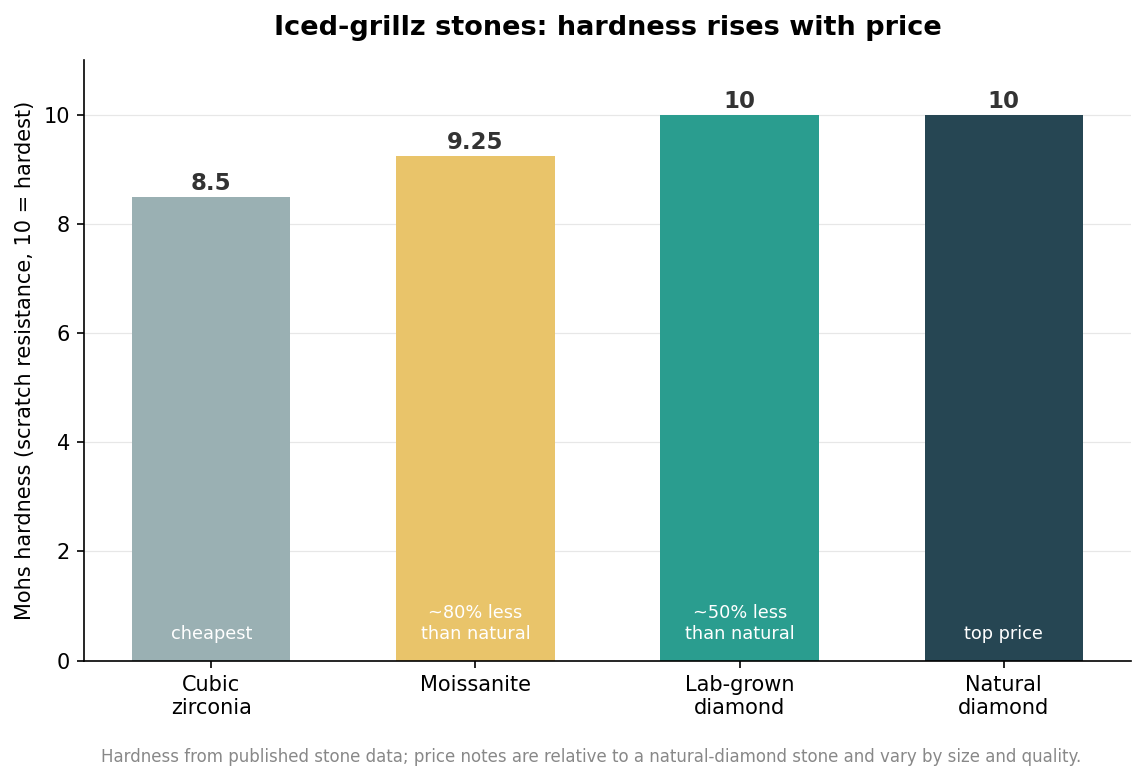
Cubic zirconia is the cheapest and looks convincing when new, but at 8.5 on the Mohs scale it is the softest of the four and the most prone to scratching and clouding over time, which is why it suits budget or short-term pieces rather than an everyday grill. Moissanite sits much higher at 9.25, throws more fire than a diamond in some light, and costs on the order of 80% less than natural stones, which is why it has become the default for buyers who want diamond-grade durability without diamond pricing. Lab-grown diamonds are physically identical to natural ones, score a perfect 10, and run roughly half the price of mined stones. Natural diamonds sit at the top on both hardness and cost. The practical takeaway is that CZ is a false economy for a piece you plan to wear constantly; moissanite is usually the sweet spot, and lab diamond is the upgrade that still undercuts natural.
Confusing gold-plated with solid gold
The gap between a plated grill that starts around ten dollars and a solid-gold piece that runs into the hundreds is not a markup — it is a different product. Gold plating is a thin layer of gold bonded over a base metal; the moment that layer wears through, the base metal underneath is exposed to a warm, acidic mouth and begins to tarnish and discolor. Solid gold does not tarnish at all. Plated pieces have their place for a costume or a single event, but treating one as a daily grill is a mistake, because the mouth is one of the harshest environments plating can face. If you want something you will wear for years, price solid gold from the start rather than replacing plated pieces repeatedly.
Picking the wrong karat
Assuming that a higher karat is simply “better” is another costly reflex. Karat measures how much pure gold is in the alloy, and pure gold is soft.
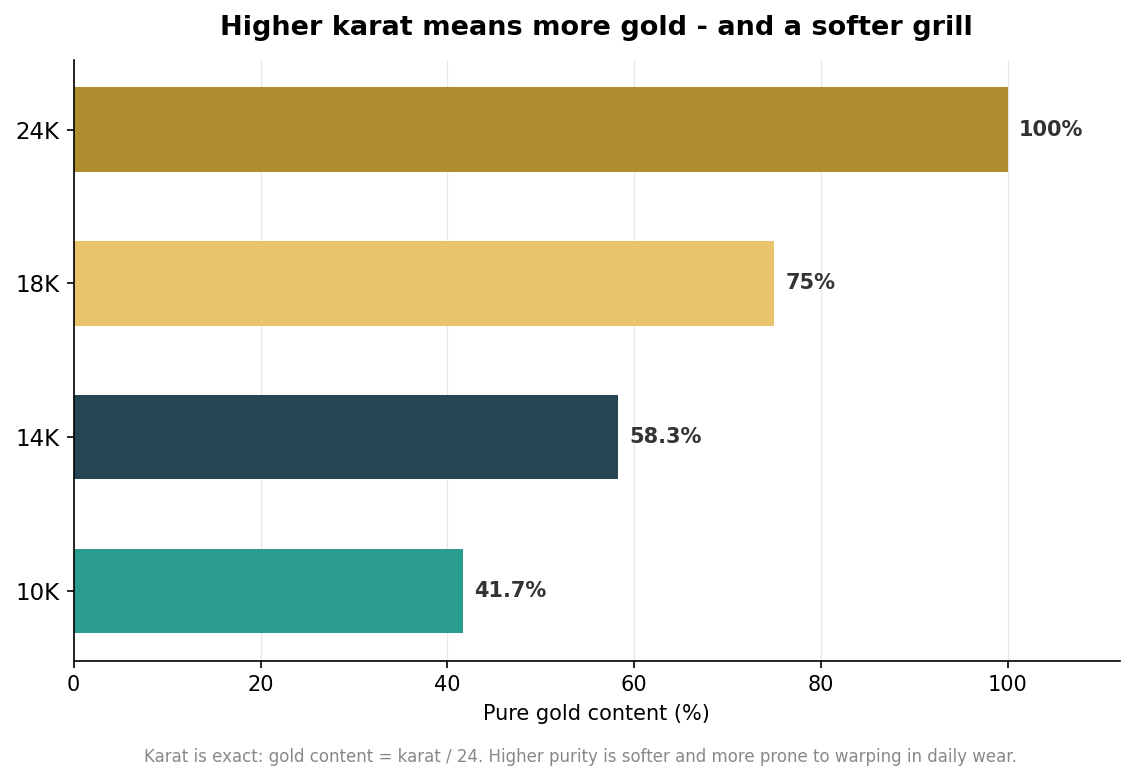
At 24K the metal is 100% gold and malleable enough to warp and bend under everyday use, which is exactly why it is rarely used for grillz. 10K gold, at about 41.7% gold, and 14K gold, at about 58.3%, contain more alloy metals and are considerably harder and more scratch-resistant, which is why they are the workhorse choices for pieces that get worn and handled constantly. 18K, at 75% gold, offers a richer color for a higher price and slightly softer metal. The mistake is paying more for a higher karat under the assumption it will last longer, when for a functional grill the lower karats are usually the more durable and sensible buy. Choose karat for the balance of color, hardness, and budget you actually want, not on the number alone.
Over-icing and under-planning the layout
Two layout mistakes round out the list. The first is over-icing a piece that will not show it — heavily setting stones across a bottom row that stays largely hidden when you talk and smile spends money where few people will see it, while the top front teeth carry most of the visual payoff. The second is ordering the wrong number of teeth for the look you are picturing; a “six” covers the front six on one row, and buyers who imagined a fuller look are often surprised when a modest count arrives. Decide how many teeth show when you actually smile, concentrate the ice and the budget there, and confirm the exact tooth count and row before casting.
How to order without paying twice
The through-line across these mistakes is that a grill is committed at the specification stage, not the payment stage. Nail the impression, match the stone to how hard you will wear it, know whether you are buying plating or solid metal, choose karat for durability rather than prestige, and place the ice where it reads. The figures here are indicative and move with stone size, quality, and current metal prices, so use them to frame a conversation with your maker rather than as fixed quotes. Get the specification right the first time and a custom grill is a one-time purchase; get it wrong and it becomes a series of them.